Saturday, 3 December 2016

Buying Land or Plot in India? Here is a 10 point checklist


Buying Land or Plot in India? Here is a 10 point checklist


Are you looking for buying a plot or a piece of land? If not today, may be you have this dream of owning a plot sometime in the future.
Buying a land has in a way become a premium thing these days especially in big cities because land is scarce commodity and the pride is associated with having your own plot where you can build the house as per your wish.
If you happen to visit any real estate exhibition, you will come across many plots projects along with the residential apartment schemes. These plots are generally within 20-100 km of the city radius and often marketed as second home or vacation homes.
On top of it the pricing is attractive (often within 5-20 lacs) and there is also the facility of installments which makes it too easy to own a plot. The deal is often pay a token amount and pay the rest amount in parts (EMI).

buying plot in india
However a common man is often not aware of the risks associated with buying land and the complexities involved in it. Buying a land is a very different kind of ballgame altogether compared to buying a flat (which is much safer), and today I am attempting to make things easy for you to understand.
My Personal Experience
I have personally visited few plot schemes myself over the last few years (near Pune). I have interacted with the sales people and have some experience in this area. Hence, I will try to share what I know with you. If you also can add to my points, I would love to incorporate it in the article.
This article will mainly help a newbie with the simple checklists which they should look at before buying a plot or when they go to visit a scheme or if they are interacting with the sales person (here is checklist for buying apartments). Note that this article is mainly keeping in mind plot schemes or gated communities, but most of the things will also apply for a standalone piece of land.

1. Is the land on the name of the builder?

The first question you should ask the sales person is that if the builder has legal rights to sell the land or not. Find out who is the current owner of the land? Is it builder himself or not?
A lot of builders either buy the entire land from the previous owner or enter into a joint agreement with the owners to sell or develop the land and sell the plot scheme. No matter what, make sure that this part is clear. Ask for the documents which clearly shows the builder has legal rights on the plot himself. Here is a story on how small builders do frauds

2. Has developer taken a loan from Bank for the project?

Builders often take bank loan for the Plot schemes and even residential schemes. It’s a sign that the builder is more serious about the project and it’s also a positive sign, because if there is the money with builder which will be specifically used for the project development. The builder is not dependent fully on the advance money the home buyers. It shows that there is a cash flow dedicated for the project and the issue of cash crunch will be minimized.
It’s not always the case the the scheme has a bank loan, but still enquire about it. If bank loan is there, its a proof that the bank has done thorough verification from their side on the legalities and only then granted a big amount (often in crores)

3. Where is the NA order ?

By default, all the land in India is AGRICULTURE LAND, unless it’s defined for some other purpose by the govt. So a piece of land is either agricultural or non-agricultural (commonly called as NA in real estate industry)
Agricultural land can be used for agri purpose, where as if you want to do any other thing other than agriculture then one has to first convert that agri land to non-agricultural (NA)
However just because a land has got NA status, does not mean that one can start using it for residential purpose, because there are various types of NA like
  • NA – Commercial
  • NA – Warehouses
  • NA – Resort
  • NA – IT
  • NA – Residential (this is the one where one can build a residential house)
So if a plot of land is type NA – Resort, that means that that one can build a resort there, but cant make a residential scheme. If a plot is NA – warehouse, then one can build a warehouse there for commercial purpose, but cant make residential schemes and sell to common man.
So you need to look for “NA – Residential” Plot
So, the point is that you need to ask to the builder/salesperson, if the plot of land you are planning to buy is “NA-Residential” or not? Ask them for a copy of that. A lot of other kind of NA plots are sold as “NA plot, collector approved” which is a misleading thing. I am attaching a sample NA order below (from Maharashtra) for you too just get a feel of how it looks like
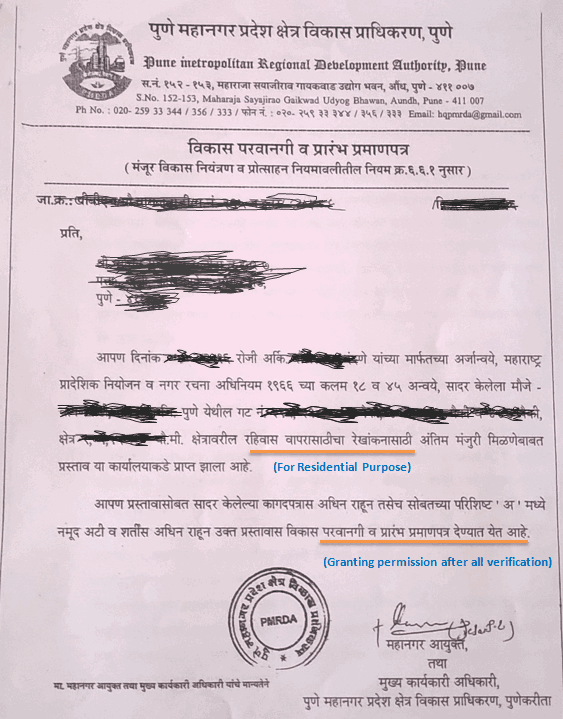
na order sample copy
Another thing you have to be very cautious is “Proposed NA” schemes. A lot of builders try to sell a non-NA land telling you that its a proposed NA land, means he has initiated the process of converting a land into NA scheme, and the papers are already in process and “very soon”, the land will become NA-residential and how you will then reap the benefits of the high prices.
While there are chances that the conversion happens, but in most of the cases, its a gimmick to sell a cheap land at high prices and often buyers are stuck in the project, because the land is nothing more than a piece of crap later.
Don’t fall for it, because converting an Agricultural land to NA-residential is a very lengthy process which a lot of approvals needs to be taken for it. There are cases where it’s been 10-15 yrs and it’s “still in process”
I suggest you read the following experience to understand more about this point.
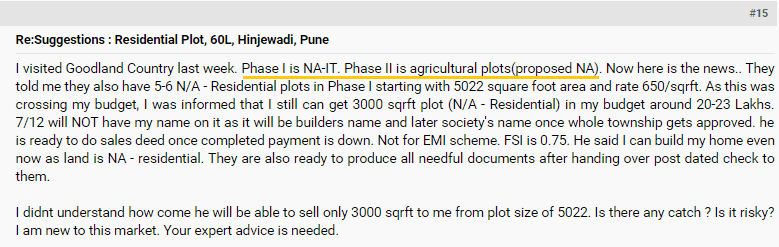
Proposed NA plots
So, ask the sales person to show you the NA order papers. Have a look at it yourself and do not fall for the promises like its coming in 2 months or next week or anything like that. Don’t get stuck into those kinds of deals.
Understand one thing very clearly, NA plots with clear title are limited and scarce, & often you will have to pay good price for it, If the land price is dirt cheap and it’s promised as NA-residential, there is a good chance that it’s fake or very very far away from the city limits.

4. What is the FSI for the plot?

Suppose you bought a plot of size 2000 sqft for building the house on it.
How much construction can you do?
Here comes the concept of FSI or Floor space index. FSI simply means how much contruction can be done on a piece of land and it depends on the location of the plot.
FSI of 100% means if you have plot of size 2000 sqft, you can build a house of 2000 sqft on that. If the FSI is 75% , then you can only build 1500 sqft of house on that 2000 sqft land.
I recently came across a project called Royal Purandar near Pune when I went to visit a plot exibition. The lady at the counter told me that the plot sizes starts from 5000 sqft and goes upto 40,000 sqft (which is very big). I was shocked to hear about so big plot sizes because 5,000 and 10,000 sqft plots are quite big.
However when I asked her what is the FSI of the plot, she told me it was just 15%. So with FSI of 15% , if you buy a plot of 5000 sqft size, you can just build 750 sqft of house, which is generally a small bungalow.
There is nothing wrong with that, but you should be at least aware about it.
Why FSI is very very imporant
So understand that FSI has a very important role to play when you will construct something or even when you will sell the plot to someone else. Imagine 2 plots which are of same size (2000 sqft) , but with different FSI like 50% and 100%
  • Plot A (50% FSI) – You can make just 1000 sqft home on that, which will be like a 2 BHK)
  • Plot B (100% FSI) – You can make a 2000 sqft home, which will be like a 4-5 bedroom Bungalow.
But then it might happen that Plot A is selling at 10 lacs and Plot B is selling at 15 lacs, and you might say – “Plot A is cheaper because its less priced and the size is same (2000 sqft)
One important thing you should know is that FSI for agricultural land is very small generally. In Maharashtra its just 4% , means even if you buy a 10,000 sqft agri plot, you can only do construction of 400 sqft on that land. You should definitely ask the builder/sales person to share the document which mentions the FSI on it. Judge the price of land only after learning about FSI, not just the area.

5. What are the other projects done by the builder?

You should ask the sales person about the other projects done by the builder. Check if they have done other similar projects in past? What was the response for it? What is the quality of those projects? Were there any legal issues with those schemes? Are the buyers happy with builder work there?
You can often get some clue about all this on the internet or the online forums. Just go to the website of the builder and find out what are the other schemes he has done. Search with the other project names and see what others are talking about?
If you get a chance, I suggest paying a visit to the past projects once. Spending half day in this will only help you further to take the decision.

6. When will the Sale Deed happen?

You will often hear about the “agreement to sale” which is executed when you book the flat/plot and clear your initial payments (around 35-40%). This is the time when you pay stamp duty and registration charges. Once the agreement to sale is completed, a lot of buyers think that the flat/plot is registered on their name and now they are legally safe.
However this is a myth and the “agreement to sale” does not make you a valid buyer. The agreement to sale (often called ATS) is just the AGREEMENT TO SALE, means it’s an agreement between buyer and seller on the initial points and terms under which the sale will happen in the future.
It mentions the terms and conditions of the deal, how much initial payments are you making along with cheque number and also the future dates, by when you will clear the payments etc.
“Sale Deed” is the document which needs to be registered in the office of sub registrar in order to make the sale happen. Unless the sale deed is done, you do not become a legal owner.
Hence, ask the builder or salesperson about the sale deed? When is it going to happen? The sale deed is generally done, only when the builder gets all the dues from your end.

7. Will I get an individual 7/12 extract in my name?

Let me first help you understand what is “7/12 extract”? Its a term which you will often hear in states like Maharashtra and Gujarat. In Karnataka its called 7/12 Uttara. It’s the document maintained by the revenue department which mentions how the land moved from one owner to another owner in last 30 yrs. So in a way its a history of the land and you will find exactly on which date who sold to whom. This way you will find out who is the current owner of the land also.
If person A sells the land to person B, then it’s important that the name is 7/12 extract is changed from A->B . Unless B name is not registered in the 7/12 extract, B will not be a valid land owner.
So it’s important to ask the seller about the 7/12 extract. There are many complications around this, like if you buy a agricultural plot from the seller in the name of “NA plot”, then your name will not be there in the 7/12 extract, because there are restrictions on who can buy the agri land and even the minimum size restriction is there.
Also at times, builder will tell you that the name of builder will be there in the 7/12 extract, and not yours. Or the society name will be there in the 7/12 extract and not yours.
Also at times, what happens is that a big piece of plot is broken down into small land areas and sold to many people and a joint 7/12 is made, where all the buyers name is there in 7/12 extract (see the conversation below), which makes things very complex in future.
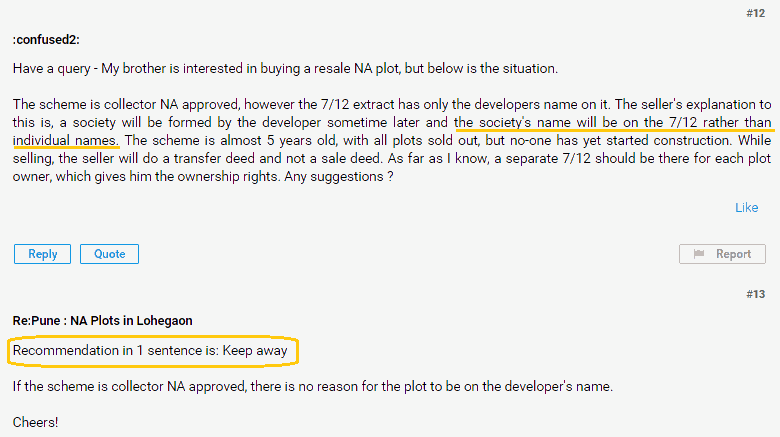
7 12 extract buying land
So make sure you enquire on this aspect properly, and if an individual 7/12 extract will be done or not.

8. What will be the per annum maintenance after buying the plot?

Once you buy the plot, there is an annual maintenance which needs to be paid which goes towards maintaining the basic amenities like security, upkeep of the project, gardens, water, security etc. It should not be a surprise for you later. This maintenance is generally paid on yearly basis and it’s proportional to the plot size. For example, if it’s Rs 4 per sqft and your plot size is 2000 sqft, then your maintenance per year would be Rs 8000.

9. Is the plot on a flat land or on a slope?

Don’t assume that your plot is always going to be a piece of flat land. If it’s a big project, it might happen that the overall land which builder has acquired is uneven or has slopes. So when it’s divided into several small plots, many plots might be on the slope or it might be uneven.
You will ask what are the main issues when we build house on land with slope or an uneven plot?
Below are some important points regarding the land on slope from this website
If the plot is on a significant slope, either the land will need to be cut and filled, or you’ll need to build a house that takes that slope into account. It’s worth remembering that while these things might make your house more spectacular, they’re also likely to cost a fair bit more.
Depending on the angle of the slope and what’s built on neighboring properties, a slope can also reduce your exposure to sunlight – which in turn can affect how much light you get in living areas, and your potential to harness the sun both for passive solar heating and for collecting solar power. Where we live in the southern hemisphere a north-facing slope is ideal for solar access – a steep south-facing slope not so much.
Below is how the project brochure looks like when its shown to you (often when the project has not yet launched or into the exhibitions)

project layout for plot
By seeing this kind of image layout, you never get an idea if a particular plot is on slope or not. So it’s always a good idea to ask this question and verify it by visiting the site yourself.

10. What are the arrangements for water and other basic amenities?

Always ask how they are going to provide water and other basic amenities. Is it going to come from municipality or the gram panchayat? Or they are doing their own arrangement for it?
What about electricity? Are they going to arrange for a individual electricity meter? How much are they charging for it? If the plot/land is too much away from the main road, then what about the access road? Who will develop it? What about fencing of plots? What about security? Ask everything in detail and in points.
With this I think we have completed the main highlevel 10 things you should ask when you are buying a plot. Below is another video on this topic where some industry level people are talking about the same issue of buying land and the complexities involved. I strongly suggest watching the 15 min long video below

Now we will see some important points which you should keep in mind before you buy the plot.
Important tips for someone buying a land
  • Do not hurry. Period! – Buying land is an emotional decision and often sales people use a lot of tactics for selling the plots (just like flats). Don’t believe the seller when they say that just 12 plots are remaining or the prices are increasing next quarter when they do their “Mega – Launch” . It never happens.
  • Make many visits to plot – Don’t book the plot just after one meeting or without visiting the plot yourself. I would say that one should make at least 3-4 visits before the deal. Try to visit the plot once when your sales person is not on the site. Just make a surprise visit and ask others on the site about important points and you might find some new information about the plot which was not told to you
  • Check the nearby development yourself – Don’t believe the salesperson about the nearby development information. If the sales person says that a new flyover is coming up nearby or if there are 3 colleges in 2 km radius, just find it out yourself.
  • Talk to people nearby the plot – If you can go a bit further, see if you can talk to people who live nearby the plot. Make a random visit and then ask the shopkeepers nearby, houses nearby on the points which concern you.
  • Bargaining for the price – Often the list price quoted for the plot is never the final price. In country like India, it’s a well known fact that there is always bargaining. So you can easily assume a 5-10% margin . Ask them to reduce up to 10% price and then settle for at least 5%. Take a lot of time to decide and often you will see the prices coming down. It’s very important that you do not show your desperation on buying and also share with them some names of nearby projects and how you also like them and you need a strong reason to buy a plot from them
  • Search online about the plot scheme or the area of land – Always search information about the project or builder online. You will often come across others who have visited the site , or interested in the same project, you can connect with them and discuss about it
I hope this article has given a good knowledge to you about the important things you should ask and keep in mind before you buy a plot into some scheme.

Beware of small unknown builders for plot projects

By now I think there is no need to tell that land buying is very complicated and one should not attempt it if you do not have the risk appetite for it. There are many small fly by night people who know how mad people can get to own a plot of land and they come up with schemes where their sole intention is to make money for themselves and cheat customers. Please see this below video where some buyers are sharing their real life experience of buying a plot and getting cheated.
I would strongly recommend that you involve a good property lawyer for verification of documents and the legality of the project. It would increase your cost a bit, but then it becomes a more secure investment.


Applying for home loan? Here are 4 highly critical checklist you should follow


Applying for home loan? Here are 4 highly critical checklist you should follow


Are you going to apply for home loan in near future? If Yes, then this article is written exactly for you, because I am going to share with you a checklist which you should follow to make sure that your loan application process is smooth and also to increase the chances of your loan application getting approved.
We all take various kind of loans these days, be it home loan, car loan, personal loans or even credit cards. I will show you some very important checklists which if you follow; you will save yourself from various issues faced by other loan seekers.
Note that while this article is primarily written with home loan in mind, but the checklists discussed will also apply for any kind of loan.
Checklist one should follow before applying for home loan in India

Checklist #1 – Check your CIBIL report/Score in advance

Don’t underestimate the role of credit reports/score in loan approval process these days. The first thing the lender looks at is your credit score/report when you apply for any kind of loan (even credit card).
The moment you enquire for loan with a lender, they check your report from CIBIL or any other credit bureau like Equifax or Experian and based on the remarks on your report and your score, they either reject your loan application or forward your case for further checks.
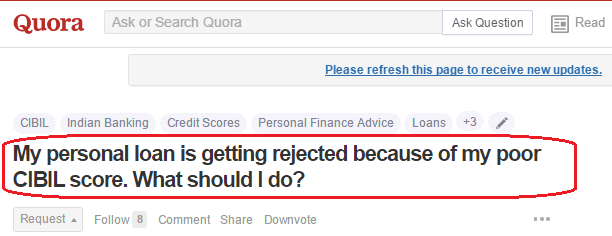
There are many real life cases, where a person applied for a loan, and found out that it got rejected because of this credit report is messed up. It might be due to a credit card settlement he did few years back or because he was not able to make timely payments on his past loans.
Imagine a person who has already paid the booking amount for a car or a house and then he is stuck because he/she can’t get the loan approved. That’s not a situation; you would like to get into!
personal loan rejected because of CIBIL
CIBIL score of 750+ is a good score
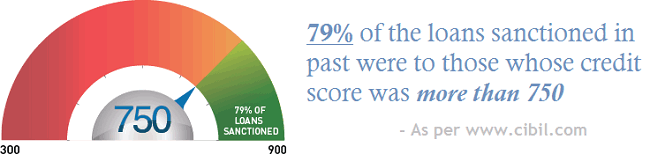
How much CIBIL score can be considered good enough to get any kind of loan? Well, there is no guarantee that you will get a loan just because your credit report is high, but as per CIBIL, out of every 100 people who got a loan approved, 79 people had a score of more than 750.
Which means that if your score if more than 750 out of 900, there is a good chance that your loan will be approved, provided there are no bad remarks on your report and other things like income proofs are in place.
cibil score required for home loan approval
Apply for your CIBIL report in advance
So when should you apply for a CIBIL report?
I think it should do it much before you apply for a loan. I suggest at least 6 months in advance, because if there is some issue in the report, you get enough time to rectify that mistake.
There are many cases, where a person applied for a home loan after paying the down payment money, and their home loan is not approved because of cibil related issues. Now they are stuck as they are not getting back their down payment money back and their application is also not getting approved.
They run around to fix their issues or try to improve their cibil score, but now it’s very late, because it takes many months to follow up with CIBIL or Banks involved. Last minutes fixes does not work, that’s the reason this check needs to be done well in advance.

Checklist #2 – Make a simple Cash flow statement

If you are applying for a big loan like a home loan or a car loan, then it’s very important to understand where you stand financially. You should have very clear idea about the maximum down payment you will be able to make (and you should also try for that) and what is the realistic EMI you can pay each month.
As our wealth is scattered across various financial products like saving bank account, fixed deposits, mutual funds etc, it’s important to note it down in an excel sheet to get better clarity.
You should also list down the income and expenses details, so that you can get an idea about how much you save each month. Your surplus each month is very important criteria used in calculating your loan eligibility by the lender.
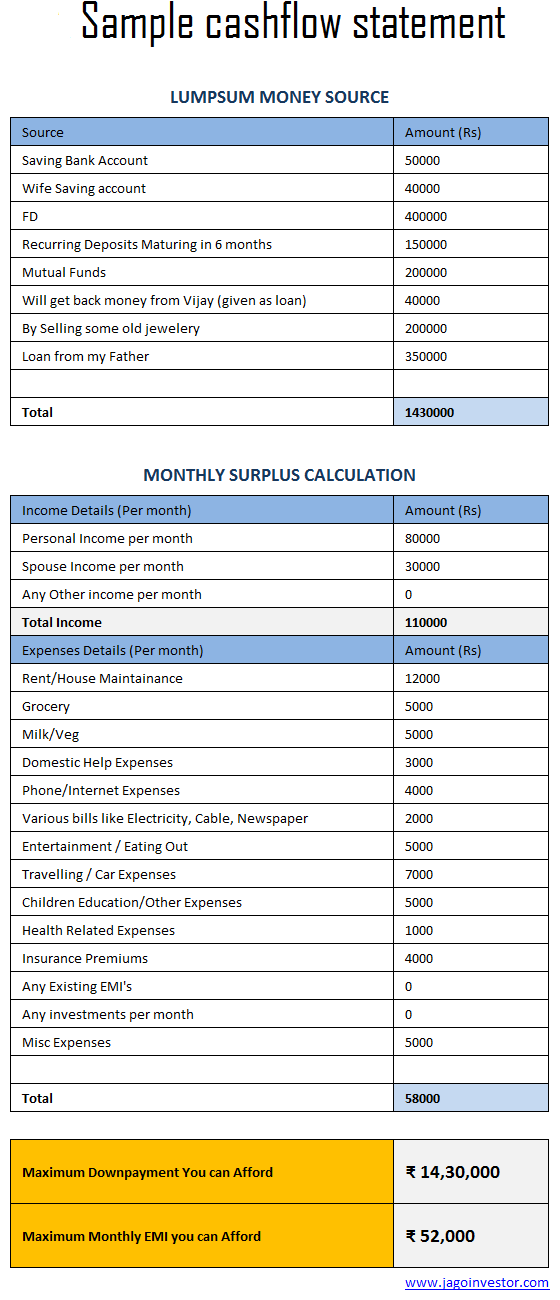
Below is a sample working of cash flow in an excel sheet, which gives the good enough indication of the down payment amount and the potential EMI a person can afford.
sample cash flow calculation before applying for a loan
It should not happen that you applied a loan much beyond your capacity and then on the last minute you are wondering from where you will arrange for extra money. It can be very frustrating situation, where you are stuck in a deal and you are not able to figure out how to arrange for the money.

Checklist #3 – Increase your home loan eligibility

When most of the buy a house, they wonder how big house they will be able to afford? Just because they have high salary, they think that they will get a big loan, which most of the times is true, if you don’t have any existing loans.
But then a lot of people have several small loans running like a personal loan or a bike loan or any other consumer loans, and these small loans come in the way of your loan eligibility because they show up in your “pending loans” or “Existing EMI” list.
So one the actions you should take is to close off any small loans you have, because they will increase your “surplus” as the EMI will get stopped, and also you will have one less commitment to take care of and lender likes that.
Below are some handy tips if you want to increase your home loan eligibility.
Let’s see an Example
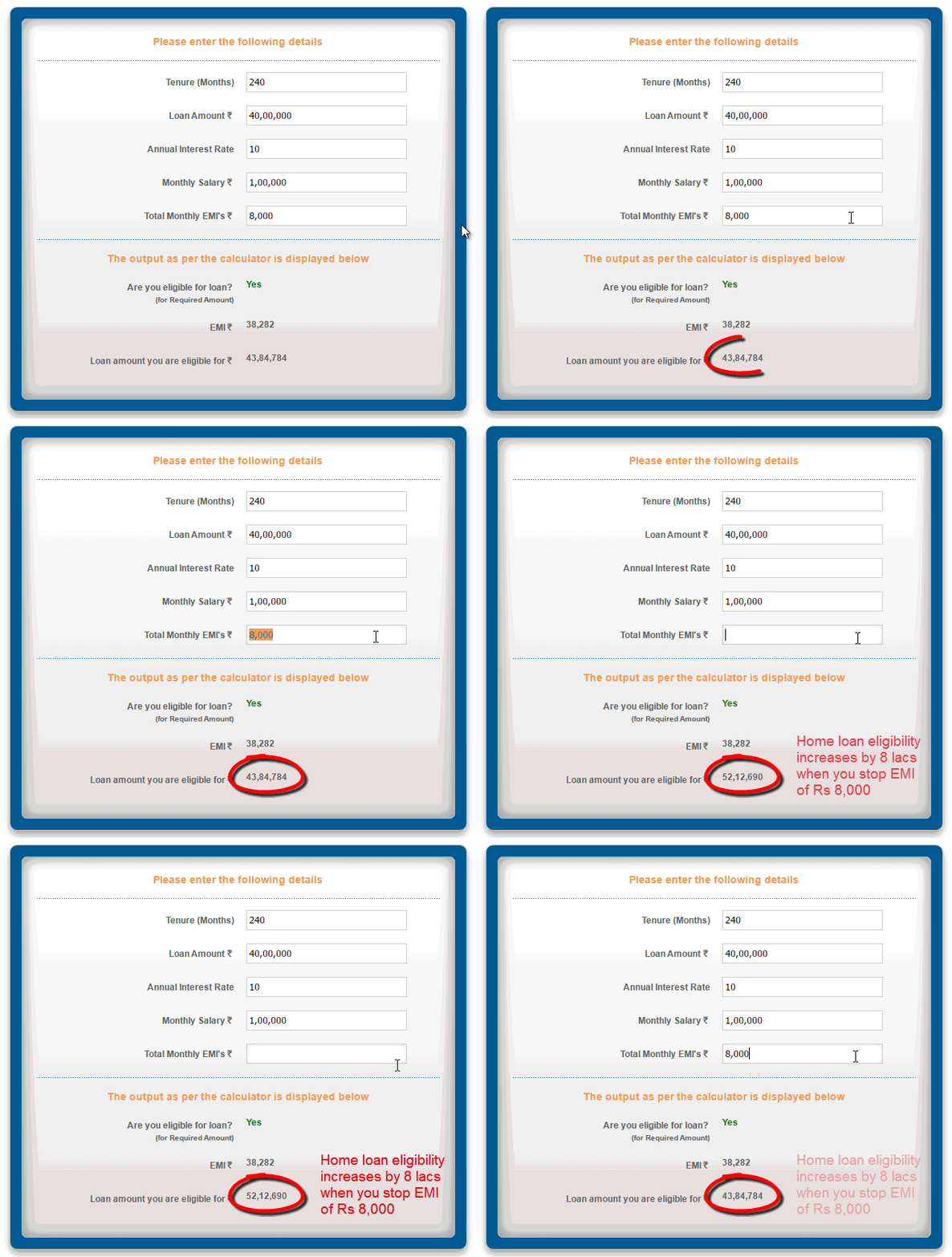
Suppose, your per month income is Rs 1 lacs and you have a bike loan (or personal loan) currently running with Rs 8,000 EMI per month with 10 more installments to go. Now with this profile you are eligible for Rs 43 lacs of home loan.
How can you increase your home loan eligibility in this case? You can prepay your entire bike loan as it’s a small loan if you look at the outstanding amount; you can dig into your other savings and pay it off. This will surely reduce your savings a bit, but increase your loan eligibility by another 8-9 lacs because now you have another Rs 8,000 surplus each month.
See the home loan calculator snapshot below which shows you this.
Home loan eligibility calculator example
Even your CIBIL report will also show that you have successfully completed and paid off a loan provided you do this few months in advance before you apply for home loan.
Close you credit card outstanding also
You should also consider to pay off your entire credit card outstanding bills. May people keep rolling their credit card debt by paying the minimum dues, but that’s not a good thing if you want to get some loan in coming future.
If you are looking for home loan, then go to this home loan eligibility calculator, enter your details and our trusted partner will help you in securing the best home loan. You also transfer your home loan by applying here
Also decide if you want to apply for a joint home loan
One way of increasing your home loan eligibility is to add your spouse or any other earning member from your family as a co-borrower of the property. This is one factor you should consider, if the spouse is already an earning member. Even if it’s not significant amount, still mentioning that they bring in some small income helps your loan application, as it adds to the “stability” factor.

Checklist #4 – Arrange all documents required for home loan

Some background preparations on the documentation front, can help you save last minute hassles and running around. I have often seen many people running around, for ITR proofs and other documents because they didn’t plan well in advance. Below are various documents which might be required for your home loan documentation purpose.
It’s a good idea to prepare a file and arrange all these documents well in advance. These documents are keeping in mind a salaried resident Indian.
KYC related Documents
  • 2-3 Passport Size photos of applicant and co-applicant
  • Identity proof like PAN or Voter ID card, Passport, Aadhar card
  • Address proof like Electricity bill, Telephone bill, Employer Certificate, Aadhaar Card
Income & Employment Related Documents
  • Past 3 months salary slips
  • 3 yrs ITR (Income tax Returns)
  • Latest 6 months bank statement attested by the bank in original
  • Latest Form 16 for 2/3 yrs
  • Proofs of all savings like FD’s, mutual funds, gold etc (for down payment)
  • All ongoing loan account statement for past 6-12 months
  • Relieving/Experience letter of previous company if current employment is less than 2 yrs old
Property Related Documents
  • Original copy for Sale Deed or Agreement to Sale
  • 7/12 extract
  • Commencement Certificate
  • NA certificate
  • Search and Title Report
  • Building Completion Certificate (if available)
  • Latest Tax receipts
  • Development Agreement
Below is a video from IREF, where a guy (seems to be from a bank) is explaining the home loan process and overall documentation requirement. It’s a 7-8 min video in Hindi, kindly view the full video to understand why some document is needed.
Extra documents for self-employed and business professionals
In case you are not a salaried person, then some documents will be different in that case, which are as follows
  • 3 yrs ITR, along with profit and loss statements certified by a CA
  • Your bank account statement for last 1 yr
  • Shop Act License
  • Partnership deed or Company related documents
  • Brief write-up about your business and nature of work/revenue
This commonfloor article mentions even detailed list of documents

Some Important points to remember before applying for home loan

  • Incase you are planning to quit your job or planning to change the job, it’s better to first apply for home loan and then quit/change, otherwise it will get very tough to get home loan later.
  • If you are sure of getting an increment very soon or your pay rise is on the cards, then wait a bit and apply for the home loan later as it will increase your home loan eligibility
I hope this article gives a clear direction and action checklist to someone who is looking forward for a home loan or any other loan. Please share any other critical checklist which I have missed out. Also I request other members to share their experience when they applied for a home loan.

Friday, 2 December 2016

Closing your PPF after 5 yrs is possible now [NEW RULES]


Closing your PPF after 5 yrs is possible now [NEW RULES]


Recently the PPF closure rules got changed and now a PPF account can be closed prematurely after 5 yrs itself, but only in some conditions which we will see in this article.
Till now, as per the old rules, the PPF account had a lock in period of 15 yrs, and in no case it was possible to close the account other than the death of the subscriber itself.
So death was the only valid reason to close the PPF account before 15 yrs maturity period.

PPF premature closure rules

As per the recent rule change by the govt, ppf closure before 15 years is now possible. You can close a PPF account if it’s at least 5 yrs old, in following 3 cases
Case #1 – Death
If the PPF holder dies, then the account can be closed anytime (even before 5 yrs) and the nominee/legal heirs can claim the amount from Govt.
Case #2 – Life Threatening illness
The PPF account can also be closed in case, the money is required for curing the serious ailment or a life threatening disease of following people
  • PPF subscriber himself/herself
  • Spouse
  • Dependent Children
  • Dependent Parents
Note that one has to provide the documentary evidence from a competent medical authority. So you will need to share the proof that you need to undergo some big treatment/surgery etc and you will need money for that.
Case #3 – Higher Education
If money is required for the higher education for the PPF subscriber or the minor on whose name the account is opened, then one can pre-close the PPF account. However one has to produce the fee bills and the proof of admission or any other documentary evidence.

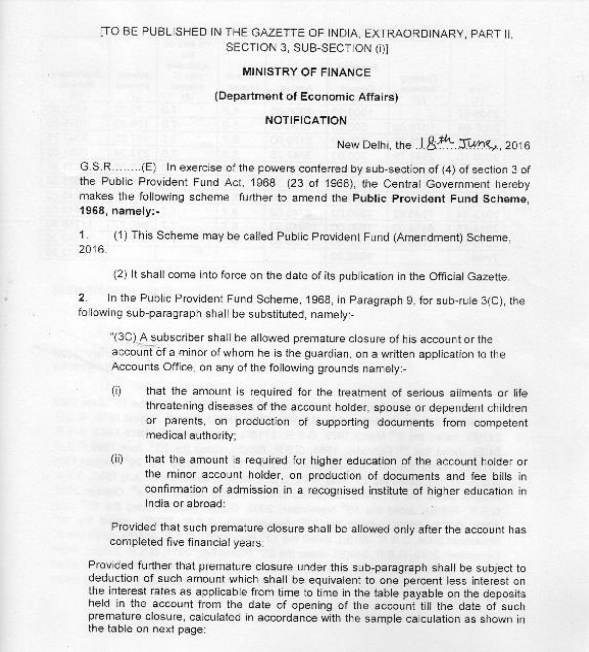
Here are the exact notification wordings
PPF pre-closure notification

Penalty of 1% when you close PPF account before maturity

This pre-close feature comes with a penalty of 1% of interest for each year. What it means is that for all the years since your PPF account is opened, you will get 1% less interest for each year. So if you earned 8.7% for a particular year, your calculation will be done @7.7% and this way for each period 1% will be reduced.
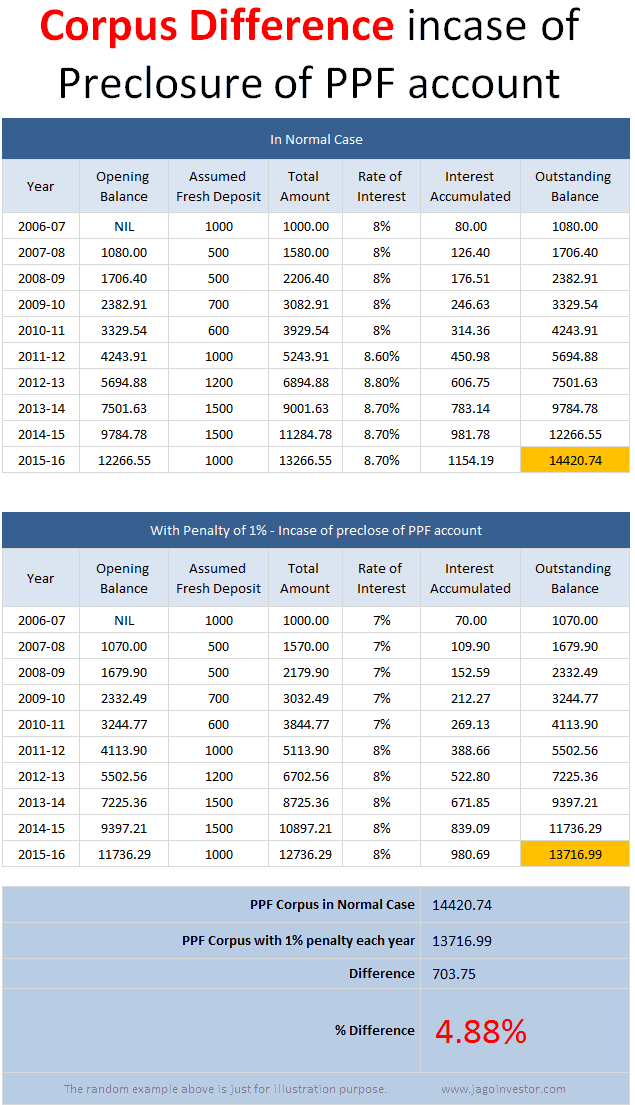
Govt has issued an example calculation for penalty of 1% . But the question now is does 1% penalty mean 1% less amount in final corpus after pre-closure?
No, the answer is 4.88% !
Yes, You get 4.88% less corpus due to this pre-closure penalty of 1% . But this is true for that example only which is given by govt in their notification. I went deeper and did the exact calculation and here are the results.
ppf pre-closure example
The reason why there is a good amount of difference is that there is the compounding of penalty in this example. If you check the balances in 3rd year, you will see there is difference of 2.1% . And it keeps on increasing as the number of years increase.
Which means, Older the PPF account, the higher is the final penalty for you.
It does not make a lot of sense to close the PPF account before maturity once 10 yrs is passed, as the penalty will be higher than 4-5% if most of the cases.

PPF pre-closure rule will help investors

PPF is one of the widely popular financial products in India. Majority of families have at least one PPF account and given it’s a long term product, there is a good amount of money lying in it. Now with this new pre-closure rule, an investor gets the benefit of closing the PPF account if they want to do it.
But the only issue is that it’s not an emergency solution to the problem as the documentation requirement is there and being a govt product, you can expect a slow response while closing down the PPF account and using the money.
Please share what do you feel about this new change in PPF closure rules?

10 steps to ensure safety of your ATM/Debit/Credit Card usage


10 steps to ensure safety of your ATM/Debit/Credit Card usage


In the last 10-15 yrs, the card usage has replaced cash transactions to a big level at least in urban India. We no longer go to banks to withdraw cash. Almost everyone prefers to pay by cards when we visit malls, grocery shops or when we fill petrol in our cars.
Increase in Card Frauds
While the ATM/Debit/Credit card usage has increased, so has the frauds related to the cards. Most of the times, the card frauds happen due to negligence of the card holder. In this post, I will talk about several things you should keep in mind which will safeguard you against a fraud or any crime which can potentially happen. The things we talk in this article will be for ATM cards, debit cards, credit cards and even internet banking transactions.
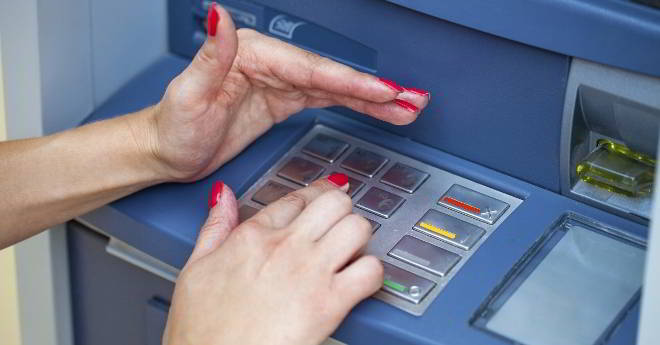
atm safety tips

1. Destroy the CVV number on the back of the card

Once you have used your ATM card several times, it’s suggested to scratch the CVV number on the back of the card. Almost everyone will memorize the 3 digit CVV number once they have used it 5-10 times. You can also write down the CVV number in your mailbox and email it to yourself if you want to record it at some place.
While this will not make you fully protected from a fraud, but it will surely reduce the chances.

2. Change the PIN as soon as your receive the card

Once you receive your card for the first time, it’s suggested that you activate it asap and then change the PIN. Try to avoid keeping the PIN’s which resemble your birthday, pincode or phone numbers. Make it a random number or some combination which you can relate to.
If you do not change your default PIN which the letter contains, it might happen that someone looks at it and misuses your card, given they have access to it. That’s the reason you should also destroy the old password document.

3. Activate SMS Alerts for any amount above ZERO

It’s suggested to activate the sms and mail alerts for all transactions.
If you do not want any sms for a specific amount like Rs 500 or Rs 1000, then you can setup the alerts above that amount, but make sure you do it. A lot of people who come from old generation like our parents, uncles etc are new to these card payments and do not activate these features. Please do it for them

4. Keep the customer care number saved on phone

It’s always a good idea to store your bank/card customer care numbers on your phone, so that you can inform them about any fraud or issues as soon as they happen.
Imagine you lost your card and you are thinking – “Once I am back home, I will call customer care and share about this incident so that they can block my card”. This is not a great situation, because within few minutes, the who has the card can swipe it and use it (given he knows other details)
Better avoid being late in informing about the incident, because once the money gets debited from your account, then matter becomes complicated and you will spend lot of times in fixing the issue and following up
Prevention is better than cure …

5. Avoid using the ATM in night or places which are not safe

There have been instances where I wanted to withdraw cash from ATM around night-time, and my wife always tell me that we can always do it next day in the morning, because it’s better to avoid ATM’s at night especially when it’s not an emergency.
I think that makes sense.
While, out of 100 times, 99 times nothing will happen. But then that one bad incident is what you want to avoid..
RIGHT ?
I am not saying that never use the ATM in night, but as far as possible, try to refrain using your cards at night at lonely places, because you never know who is keeping an eye on you..
Here is a video from Bangalore, where a 38 yrs old lady was attacked by a guy inside the ATM. Something like this is very much possible to happen if you take things lightly at night when it’s lonely.
Hence, if are going back to home in midnight and thinking of withdrawing cash from an ATM which is located at a lonely road, I suggest that you avoid it unless it’s emergency. It’s always safer to come back in morning and withdraw the money from ATM.

6. Don’t let any once enter the ATM while you are using it

If there is only one single ATM machine inside the room, then don’t allow anyone enter the ATM when you are using it. You can directly tell the person to enter the room once you have used it.
At times, People are not civilized enough to understand that ATM usage is a very private activity and they should not enter or look at your screen.
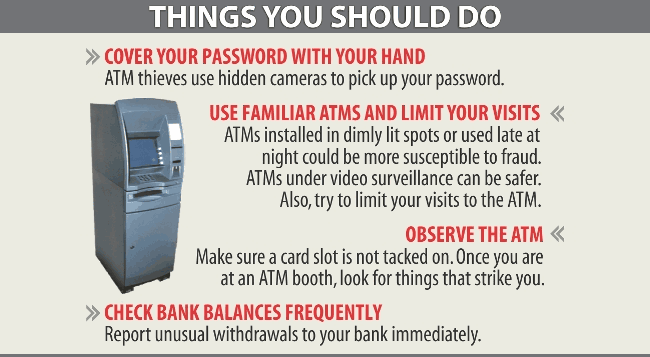
stop atm fraud

7. Never leave an incomplete transaction

There are many ATM frauds which has happened because the person left without completing their transaction. You should never leave ATM screen unless the “welcome screen” appears back.
There are cases, where the computer hang in between the transaction either because of a technical issue or because someone had done some trick to it. Always press the cancel button once you are finished or sense that there is some issue.
Below is an excerpt from a report from Indian express which shares more details about keypad jamming fraud in ATMs.
Keypad jamming fraud
The risk department of the banks have termed it so because the modus operandi of defrauder involves jamming both the ‘Enter’ and ‘Cancel’ buttons on the ATM machine by applying glue or by inserting a pin or blade at the edge of the button. So when the customer tries to press the ‘Enter/OK’ button after entering his ATM PIN, the key does not function and the customer can’t proceed with his transaction. At this juncture the customer thinks that the machine is not working and tries to cancel the transaction, which also does not go through as that button is also jammed. Thinking that the transaction is cancelled, he leaves the ATM machine.
As soon as the customer leaves or is prompted to visit the nearby ATM machine, the fraudster takes over the machine and since the transaction is active for around 30 seconds in most cases (some banks have reduced it to 20 seconds), he keeps the transaction active by pressing some functional buttons and in the meantime removes the glue or pin from the ‘Enter’ button to go ahead with the transaction. The fraudster then withdraws the cash from the customer’s account, leaving the customer unaware of the fraud till he checks the message from the bank.
If your ATM screen is hanged or incase of any issues, make sure you contact the security guard or at least call the customer care while you are inside the ATM.
All ATM’s have cctv machine and it will record your activity which will help you later in case of any problem or dispute. Here is a real life case of how ATM fraud can happen from a fellow blogger BasuNivesh.

8. Never share your debit card PIN when you shop

When you go to Petrol Pumps to fill your car or while you are dining at restaurants, try to avoid sharing the ATM PIN while making the payments. A lot of people let others enter their PIN, because they don’t want to walk all the way to swipe machine.
I prefer to walk down and enter the PIN myself or ask them to bring the swipe machine near me.
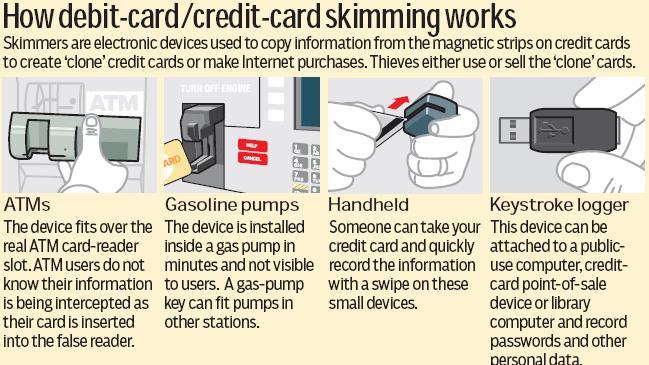
While it surely adds to convenience by sharing the PIN, but it also exposes you to the risk of debit/credit card fraud. No one is stopping the person who has your card to note down your card number, expiry date, CVV number (most of the people don’t scratch it) and write down the PIN you shared with them. In some extreme cases your card can be swiped to skimming machine to steal the information and duplicate the card.
how debit and credit card skimming work
A lot of people think that just because someone has their card details, they are still secured because the OTP comes to their mobile or the 6 digit extra password is asked while doing transaction online. However, they are mistaken.
While one will surely fail while doing the transactions in Indian websites, they will succeed while using the card on international websites, because OTP is not sent there. Also that extra layer of 6 digit password is not asked while doing transactions at many websites outside India.

9. Never share your PIN, OTP , CVV and other sensitive details

My father in law is a senior citizen and despite being a bank employee for many years – I can clearly tell you that even he might fall prey to many online frauds related to banks because he is very new to these card payments and internet banking. He belongs to that old era and his banking is very different than the today’s banking.
Like him, your parents, and grandparents and in laws will surely be from the generation who does not understand very well how these online things work.
When they get a call from someone who says – “I am calling from Bank and …”, for them it’s a genuine call and they can’t tell a difference between fake call and a genuine one. And they are always on the list of fraudsters.
There are various online frauds going on these days, where a person poses as a bank employee and then scares the person on other end saying things like
  • “This is a verification call from bank, please share the OTP which has just come on your mobile”
  • “You will now get a new card because the old one is cancelled, please share the 3 digit on the back of the card to approve this”
  • “We notice that a 20,000 transaction has happened just now, did you do it? Please share an OTP which has come to your mobile to verify that you are the card holder”
Listen to this YouTube conversation, where a girl is posing as SBI staff and trying to get information. Imagine if your parents or some senior citizen gets this kind of call, how will they react?
Here is a good FAQ related to fraud protection related to cards from ICICI bank

10. Don’t expose the cash withdrawn from ATM

I have done it few times, and I now understand that it was a mistake.
When you take out cash from ATM, if it’s a big amount – many times few people come out of ATM holding the bundle of cash without realizing that someone might be watching them.
It’s always suggested to keep a bag with you and put the cash inside it or at least keep the cash in your wallet or pocket till you reach your car or home. There might be many bad elements nearby and they will keep an eye on you. They might be behind you and later they may attack you. What they show in CRIME PETROL actually happens in real life too ðŸ™‚

Don’t get Paranoid

While it’s suggested that you should be alert and careful while using your cards or internet banking, but I would like to also add that you should not become paranoid and start behaving like a maniac :). You should judge the situation and use your presence of mind when someone is really being helpful and when someone is trying to trick you.
Please share any other tips or suggestions which I have not added above.